Minna coordinates Sense Financial's communication efforts towards educating clients about the Self Directed IRA and Solo 401k. She enjoys the opportunity to work with clients from various backgrounds, experiences, and goals. She strives to ensure that each client’s goals are met through the products Sense Financial offers.
When the IRS releases an amendment or restatement, your Solo 401k must adopt it to remain compliant.
SECURE amendment
The IRS is releasing an interim amendment ("SECURE amendment") for 2026. You, as plan sponsor, must adopt this amendment by December 31, 2026 in order for your Solo 401k to remain compliant.
The SECURE amendment is a “good faith” amendment which retroactively applies provisions to your plan from the following:
SECURE Act of 2019
Miners Act of 2019
CARES Act of 2020
SECURE 2.0 Act of 2022
Adopting the amendment
As document sponsor, Sense Financial will process the amendment for your plan once it is released by the IRS.
When it's ready, we will email you the SECURE amendment via ZohoSign
Electronically sign the amendment documents
Once signed, a copy will be automatically emailed to you by ZohoSign
Keep this signed amendment in your file
This completes the required adoption of the SECURE amendment
Beneficiaries are required for your Solo 401k. And you, as plan administrator, are responsible for keeping a correct and updated version of the beneficiary designation form at all times.
When you first established your Solo 401k, you should have completed and saved the form in your file
At any time, you can also complete another form to designate or update your beneficiaries
At least one primary beneficiary at 100% is required. Additional primary and contingent beneficiaries are optional.
If you are married and designating someone other than your spouse as 100% primary beneficiary, the form must be signed by your spouse in the spousal consent section and notarized
If you are married and designating your spouse as 100% primary beneficiary, the form does not need to be notarized
If you are single, the form does not need to be notarized
Your beneficiaries can be updated at any time by you by completing another form and checking “Change” on page 1.
Who does the form go to?
Once you have completed and signed the form, you would give a copy to:
Your file as Plan Administrator
Your co-trustee or successor trustee, if applicable
The individual/company handling your estate planning matters
Since your plan is structured without a custodian, you are not required to give a copy to Sense Financial. Sense Financial is the document sponsor of your plan only; we are not the custodian since there is no custodian for your Solo 401k.
Does the Solo 401k get its own EIN, separate from the EIN of my business?
If I’m a sole proprietor, do I need to get an EIN for my sole proprietorship? I’ve been using my name and my Social Security Number for everything related to my sole proprietorship, like filing taxes.
Your Solo 401k plan documents will list the EIN of the adopting business and the EIN of the Solo 401k.
Solo 401k has its own EIN
The Solo 401k is a separate entity from you and your business. The Solo 401k has its own EIN.
When we create your plan documents, we obtain the Solo 401k EIN for you. The Solo 401k EIN will be listed on your plan documents and included in your set of plan documents.
Your adopting business has its own EIN
Your adopting business, which represents your self-employment, should have its own EIN
This is separate from the EIN of the Solo 401k, which we will obtain for you
We do not obtain the EIN for your adopting business
EIN for sole proprietorships
If your adopting business is a sole proprietorship, an EIN for the sole proprietorship must be listed on your plan documents.
The plan documents should not list your Social Security Number as the business number of your sole proprietorship
The sole proprietorship EIN is separate and different from the EIN for the Solo 401k
If you are a sole proprietor, and you have used your name and SSN for your sole proprietorship, you can continue to do so as it relates to your business
When filing taxes for your sole proprietorship, for example, you can continue to list your SSN on the tax return, while noting the EIN of your sole proprietorship in Section D of your Schedule C
Use the appropriate EIN for your business and for your Solo 401k
When conducting your self-employment business, use the EIN for your self-employment business
When investing with your Solo 401k, use the EIN for your Solo 401k
Corporations or LLCs with corporation elections are required to pay a reasonable compensation.
An officer of a corporation who provides services to the corporation is generally considered as an employee of the corporation
The Internal Revenue Code establishes that any officer of a corporation, including S corporations, is an employee of the corporation for federal employment tax purposes. S corporations should not attempt to avoid paying employment taxes by having their officers treat their compensation as cash distributions, payments of personal expenses, and/or loans rather than as wages.
As an officer of a corporation, you must be paid reasonable compensation
Reasonable compensation is defined as “commensurate with your duties” and “the value that would ordinarily be paid for like services by a like enterprise under like circumstances” (from the IRS articles below)
Reasonable compensation is subject to employment taxes
Reasonable compensation must be processed via payroll on a W2
Your W2 figure is the starting figure to calculate contributions from
Pass-through income reported on Form 1120S (Schedule K-1) is not considered self-employment income and cannot be counted toward calculating contributions to the Solo 401k for those with a corporation
Your Solo 401k contributions are based on your compensation from the adopting business of your Solo 401k. Your compensation determines the amount you can contribute.
Compensation must come from the adopting business of your Solo 401k, not from an outside company or source
Compensation is what that adopting business is paying you
Compensation is subject to self-employment or payroll taxes
You cannot contribute more than what you earn in compensation
Since your Solo 401k contributions are based on your compensation, it’s important to define compensation correctly.
So what is compensation?
Compensation is active, not passive, income
Active income is earned from your business activity. Rental income from properties is passive and would not qualify as compensation.
Defining compensation depends on the tax status of the adopting business
If your adopting business is a:
Sole proprietorship (or LLC taxed as a sole proprietorship)
Partnership (or LLC taxed as a partnership)
Your compensation is defined as “earned income”. This is roughly:
Net earnings (business revenue – business expenses) – ½ your self-employment tax
*Technically, your final compensation figure as a self-employed individual would not include your contributions, as they will be deducted. However, the above formula can be a start for calculating the compensation figure. This is a “circular calculation”- your compensation figure depends on your contribution figure, and your contribution figure depends on your compensation figure.
If your adopting business is an:
S-corporation (or LLC or partnership taxed as an S-corporation)
C-corporation (or LLC or partnership taxed as a C-corporation)
As plan administrator, you are responsible for administering the plan according to the plan documents and in compliance with the IRS.
Your responsibilities as plan administrator include:
Keeping records of all plan activities
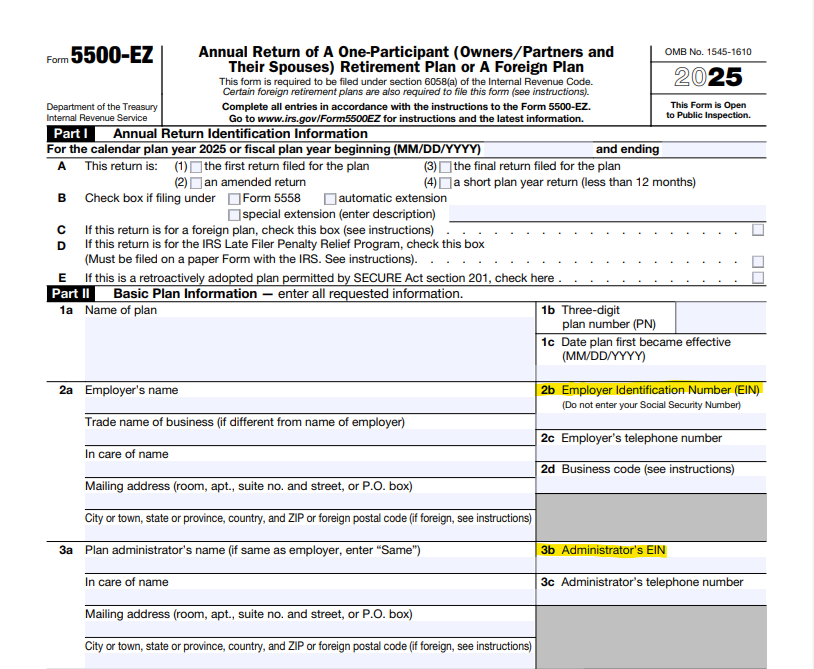
Filing on behalf of the plan as needed, including 1099-Rs and 5500-EZs
Ensuring participant loans, if any, are being paid back in a timely manner
Keeping records of all plan activities
Recordkeeping is one of the main responsibilities of the plan administrator. You will need records of all contributions, distributions, investments, etc.
The Miscellaneous Forms section contains forms that you can complete and keep in your files as plan administrator:
Separate accounts are required by your plan. They must be established for each participant and per type(s) of funds within the plan. They are also helpful for tracking the balances of each type of fund within your 401k.
Filings on behalf of the plan as needed, including 1099-Rs and 5500-EZs
You are also responsible for all filings on behalf of the plan. Depending on the activities and value of your plan, you may be required to file a 1099-R and/or a 5500-EZ:
Ensuring participant loans, if any, are being paid back in a timely manner
If a participant loan is taken from your Solo 401k, you also become loan administrator. You must ensure that all participant loans are being repaid in a timely manner, according to the repayment schedule established at the time of the loan.
Starting in 2026, all catch-up contributions made to the Solo 401k by a higher-paid employee must be made as a Roth. This is per the IRS’s recently released final regulations for the SECURE Act 2.0, Section 603.
What are catch-up contributions?
Individuals who are 50 and above by the end of the taxable year are allowed to make catch-up contributions to their 401k
In 2025, the catch-up contribution limit was $7,500
Individuals who turn 60, 61, 62, or 63 by the end of the taxable year are allowed to make super catch-up contributions to their 401k
In 2025, the super catch-up contribution limit was $11,250
The mandatory Roth catch-up contribution applies to both types of catch-up contributions listed above
Catch-up contributions were allowed to be made as pre-tax or Roth in previous years, but SECURE Act 2.0 now requires that all catch-up contributions must be made as Roth, starting in 2026, if made by a higher-paid employee
What is a higher-paid employee?
The IRS defines a higher-paid employee as an individual who earns more than $150,000, indexed, in W-2 wages from the adopting business of the plan. This is the figure reported in Box 3 of your W-2 from the adopting business of the plan.
This definition applies to W-2 employees only
If you are a sole proprietor, for example, and are not a W-2 employee of your adopting business, you are not defined as a higher-paid employee. You would be able to make your catch-up contribution as either pre-tax or Roth.
To review, the mandatory Roth catch-up contribution applies only to:
Any participant who is 50 and above by the end of the taxable year, and
Who wants to make a catch-up contribution to their Solo 401k, and
Who is a W-2 employee of the adopting business of the plan, and
Whose wages for the preceding year exceed 150,000 (indexed)
Additional background
The SECURE Act 2.0, Section 603 required that certain participants make all catch-up contributions as Roth for taxable years after 2023
However, the IRS designated 2024 and 2025 as “administrative transition” periods in which catch-up contributions could still be made as pre-tax, without violating SECURE Act 2.0
The IRS recently released final regulations which confirm: the mandatory Roth catch-up contribution will be required for all taxable years, starting in 2026
For more information on calculating and making contributions, please visit our contributions page:
The SECURE Act 2.0 introduced a new limit to catch-up contributions to your Solo 401k, if you are age 60-63. These are referred to as “super catch-up contributions.”
Individuals who are 50 and above by the end of the taxable year are allowed to make catch-up contributions to their 401k
In 2025, the catch-up contribution limit was $7,500
Individuals who turn 60, 61, 62, or 63 by the end of the taxable year are allowed to make super catch-up contributions to their 401k, which are 150% of the normal catch-up contribution limit
In 2025, the super catch-up contribution limit was $11,250. In 2026, the super catch-up contribution limits remains at $11,250.
Super catch-up contribution limits are applicable only for those years in which a Solo 401k participant turns 60, 61, 62, or 63 by the end of the taxable year, starting in 2025.
Once the Solo 401k participant turns 64, they cannot make super catch-up contributions and are again subject to the regular catch-up contribution/for those age 50 and above.